
As concerns mount over the environmental impact of mercury-based ultraviolet (UV) lamps, the water treatment industry is embracing a game-changing technology: UVC light-emitting diodes (LEDs). These innovative devices offer a sustainable and efficient solution for point-of-entry (POE) water disinfection, addressing both regulatory challenges and consumer demands.
Traditionally, POE water treatment systems have relied on UV mercury lamps to provide microbially safe water throughout residential and commercial buildings. However, with the Minamata Convention and growing consumer awareness, the phase-out of mercury-based products is on the horizon. This shift has prompted original equipment manufacturers (OEMs) to explore alternative technologies, and UVC LEDs have emerged as a promising contender.
Moreover, the industry is grappling with regulations surrounding per- and polyfluoroalkyl substances (PFAS), commonly known as “forever chemicals.” These regulations aim to reduce exposure to PFAS by addressing both production and abatement processes. POE water treatment plays a crucial role in ensuring compliance and safeguarding water supplies in residential, commercial, and public buildings.
Traditional POE treatment methods, such as reverse osmosis (RO) and granular activated carbon (GAC), effectively remove trace PFAS chemicals from incoming water. However, these processes also strip away protective agents like chlorine, increasing the risk of opportunistic property piping pathogens (OPPP) and biofilm growth. UVC LED technology offers a solution by providing effective disinfection without compromising the water’s potability.
Advantages of UVC LED Technology
UVC LEDs offer several advantages over traditional UV lamps, making them an attractive choice for POE water treatment systems:
- Energy Efficiency: UVC LEDs consume significantly less energy than mercury-based lamps, resulting in lower operating costs and a reduced environmental footprint.
- Longer Lifespan: With a lifespan of up to 10,000 hours or more, UVC LEDs require less frequent replacements, minimizing maintenance costs and downtime.
- Compact Design: The compact size of UVC LEDs allows for more design flexibility, enabling the integration of disinfection systems into space-constrained environments.
- Optimal Wavelength: UVC LEDs can be precisely tuned to emit light at the optimal wavelength for disinfection, maximizing their effectiveness while minimizing energy consumption.
- Instantaneous On/Off: The ability to instantly turn UVC LEDs on and off enables precise control over the disinfection process, ensuring optimal performance and minimizing the risk of under or over-exposure.
Improving Performance and Meeting Regulatory Demands
As the performance of UVC LEDs continues to improve, their adoption in POE water treatment systems is becoming increasingly viable. These devices offer a tremendous benefit in UV efficiency due to their targeted wavelength emission, which disrupts the DNA of microorganisms, rendering them unable to reproduce.
By selecting the appropriate target microbe (biodosimer) and calculating the required dosage for a specific log reduction, reactor designers can optimize UVC LED systems to meet industry standards and regulatory requirements. The focused and intense UVC energy emitted by LEDs allows for more efficient disinfection, often requiring less energy than traditional mercury-based systems.
State of POE Systems Today
Point-of-entry (POE) UV treatment systems today can have a wide range of flow rates, typically between 5 to 30 gallons per minute (gpm). The disinfection dosage performance can also vary significantly, ranging from 16 mJ/cm2 to 40 mJ/cm2. Generally, as the flow rate decreases, the required dosage for effective disinfection increases. A common configuration involves a 35-watt low-pressure mercury lamp for a 9 gpm flow rate, providing 11.5 watts of UVC energy at 254 nm wavelength and a dosage of 30 mJ/cm2.
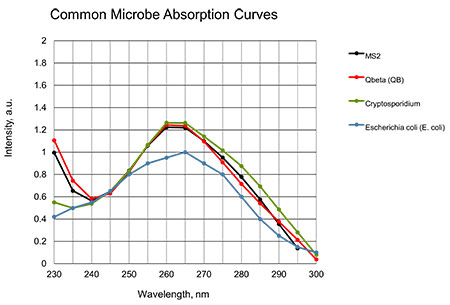
UVC LEDs are available in various peak wavelengths, with those in the 260 to 270 nm range offering more consistent performance across multiple microbes. Unlike lamps that emit energy along their entire length, LEDs provide intense UVC energy that can be focused and directed within the system, acting as a point source. This focused intensity, combined with the optimal wavelength for disinfection, means that LED-based systems require less UVC energy than mercury-based systems for the same level of performance.
Consider a POE system operating at 9 gpm and requiring a 3-log reduction of Q Beta. At 254 nm, the required dosage for a 3-log reduction of Q Beta is 34 mJ/cm2. However, using the absorption curve, the required dosage at 265 nm can be calculated as 28 mJ/cm2. While a 35-watt mercury lamp provides nearly the required UVC energy (11.5 watts for 30 mJ/cm2), an LED emitting in the peak germicidal wavelength range of 260 to 270 nm would only require approximately 9.5 watts to achieve the same disinfection performance.
| Microbe | 1 LRV | 2 LRV | 3 LRV | 4 LRV |
| MS2 | 16 mJ/cm2 | 34 mJ/cm2 | 54 mJ/cm2 | 78 mJ/cm2 |
| Q Beta | 11 mJ/cm2 | 22 mJ/cm2 | 34 mJ/cm2 | 46 mJ/cm2 |
| Cryptosporidum | 4 mJ/cm2 | 9 mJ/cm2 | 13 mJ/cm2 | 17 mJ/cm2 |
These calculations assume a basic reactor design with moderately reflective surfaces. Reactor design can be further optimized to balance the specifications of the existing technology with the desired disinfection performance and economic goals of the application.
Embracing the Future of Water Treatment
As the global regulatory environment shifts towards mercury bans and stricter PFAS regulations, the interest in UVC LED technology for POE water treatment applications is rapidly growing. OEMs are recognizing the advantages of this innovative technology, including improved performance, energy efficiency, and sustainability.
At the forefront of this technological revolution, companies specializing in UVC LED-based reactor design are enabling OEMs to leverage the full benefits of this platform across their product lines. As the market demand for UV disinfection in POE systems expands, more manufacturers are expected to embrace UVC LEDs as their preferred technology, driving further advancements and widespread adoption.
By embracing UVC LED technology, the water treatment industry is paving the way for a more sustainable and efficient future, ensuring the provision of safe and compliant water supplies for residential, commercial, and public buildings worldwide.