
Recent concerns around the energy consumption of AI platforms like ChatGPT has highlighted how the design of data centers will impact the global energy ecosystem. In the design of these systems, UVC LEDs offer a unique opportunity to help improve system efficiency.
As processing power increases, so does total energy loss which increases operating temperature in the racks. This has increased the focus on effective, energy-efficient heat management to improve overall system efficiency. To cope with the increased heat, data centers are replacing and enhancing traditional cooling systems rely on air-cooled racks with liquid-cooled approaches, which can be anywhere from 50 – 1000 times more efficient.
Methods for active cooling and typical flow rate within the system
Long proven for mainframe and gaming applications, liquid cooling is expanding to protect rack-mounted servers in data centers worldwide. Some liquid cooling systems can reduce energy costs up to 40%, reduce data center noise by 55% and reduce electricity infrastructure costs by 89%.
The flow rate of water in an AI data center can vary widely based on the cooling system design, the size of the data center, the heat load generated by the servers, and the efficiency of the cooling technologies used.
Cooling Tower Systems:
For large data centers, cooling towers are commonly used to dissipate heat. A typical large data center might require flow rates in the range of 500 to 5,000 GPM or more, depending on the scale of operations and the local climate.
Chilled Water Systems: Chilled water systems circulate water through heat exchangers to cool the air that is then used to cool the servers. Flow rates in these systems can range from 1,000 to 10,000 GPM for large data centers.
Direct Liquid Cooling (DLC) Systems: Some data centers use direct liquid cooling systems where water (or another coolant) is circulated directly to the server components. Flow rates here might be lower compared to cooling towers, often ranging from 10 to 100 GPM per cooling unit or server rack.
Liquid cooling, while efficient for managing heat dissipation, introduces the potential for biofilm growths which can greatly decrease system efficiency.
The impact of biofouling on water efficiency
As water carries heat from the racks to the recirculation and cooling tanks, it an become susceptible to microbial contamination. These microorganisms can form biofilms on the surfaces of the cooling system, further reducing heat transfer efficiency and leading to blockages.
As water is cycled throughout the system, the chance of biofilms developing and reducing overall efficiency of the system increases. Adding ultraviolet (UV) disinfection to the recirculation cycle allows these systems to maintain a level of water treatment that ensure optimal performance.
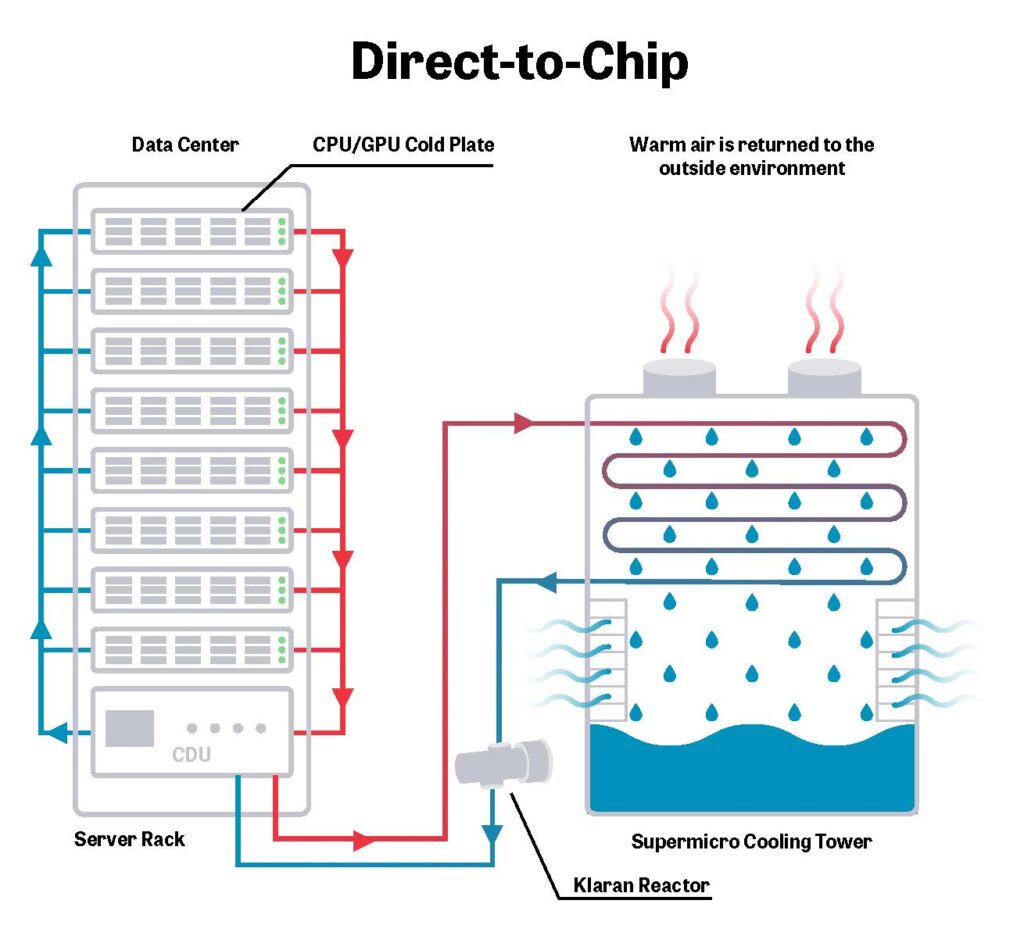
UVC LED-based solutions present an ideal solution to maintain water quality in these active cooling systems as they can be operated with a duty cycle to maximize the disinfection while optimizing power consumption and lifetime. Studies have shown than pulsed UV can be more effective at controlling biofilms, which means that the LED-based systems could deliver reliable, consistent water treatment for years with minimal impact on power consumption and maintenance costs.
Liquid cooling, both direct and indirect, are not simply a passing fad since their advantages have become more compelling with each generation of IT equipment. As a result, facility managers, data center managers, and thermal engineers are recognizing the merits of liquid cooling and there is a growing trend in its application to the IT environment.