
Commercial UVC LEDs for disinfection have been in the market for almost a decade now – and they are a known entity in point of use (POU) applications where on demand operation now makes them the technology of choice for these designs. UVC LEDs provide designers with a more effective germicidal light source, more design flexibility, and reduced cost of ownership for the end user – a win-win.
But in POU disinfection applications, designing for end of life is of the utmost importance – it’s not the first glass of water you need to be concerned about, it’s the very last. And while UVC LEDs are known to offer a longer lifetime if engineered correctly – in some cases, they can last beyond 40,000 hours of operating time – lifetime is not a fixed specification.
To ensure disinfection performance in your application is as good at the end of the product’s life as it is out of the box, you need to understand the relationship between UVC LED lifetime and reliability.
Lifetime vs Reliability: Explained
When selecting a UVC LED to meet application requirements, understanding the role of device reliability and its relationship to lifetime is an important distinction to understand.
What do we mean by reliability?
When we’re talking about product reliability, we are referring to the percentage of the LED population operating outside specifications. For a given forward current and operating temperature, there will be a natural statistical distribution of light degradation (or lifetime). The percentage of devices in a population which exhibit light output below a specified L value is known as the B value.
Lifetime, on the other hand, refers to the end of life of a specific LED. Let’s look at the definitions of both the L value and B value:
LXX (L-value): Used to specify end of life for a UVC LED at the point where the UVC output has degraded to XX percentage of its initial value.
BXX (B-value): The XX percentage of the population diodes which will (statistically) fail a defined target after a certain time for a given forward current and temperature condition.
LXXBXX value indicates the real lifetime at a certain hour.
Figure 1 (below) provides different LEDs behaviors based on B values of a population. The solid line shows that at 10,000 hours, under the specific operating conditions 50 percent of a sample population (the average) will emit 70 percent of the initial output, while 50 percent of the sample population will emit something less than 70 percent.

The dotted line in Figure 1 shows data for B10 of this group of devices. The B10 line shows that at 10,000 hours only 10 percent of devices emit less than 50 percent of their initial output—which is the L50B10 value.
It’s important to note, however, that there are many factors that impact reliability and lifetime. For instance, humidity, current and voltage, temperature, mechanical forces – all of these dictate how long a product will last without failure.
What Does This Mean?
Designers and engineers need to understand UVC LED lifetime and reliability because they wouldn’t want to put their customers at risk should a product suddenly stop providing effective disinfection. Managing the end of life of a product requires careful planning – starting during the design phase. Engineers should understand what amount of UVC power would be required for the last glass of water. Then, they need to calculate the cumulative on time for their product lifetime. Because of the instant on/off nature of LEDs, it’s this cumulative on time that is the required device lifetime.
In some industries like consumer goods, designers might choose to design to the lowest cost solution – this allows companies to stay competitive in the market. But for other industries like healthcare, designers would want to design to the highest level of disinfection confidence. A lower cost but ineffective disinfection design could not only cause a major PR crisis, but it could hurt a company’s profits in the long run. Plus, lower cost solutions often require the fewest number of LEDs possible, which leaves little to no room for error in critical infection prevention equipment. If half the LEDs fail, you risk delivering less than the required disinfection dose.
To increase product quality, design engineers need to look at lifetime performance at lower B values, like the red line in Figure 1. By understanding this data, the total UVC power required at the end of life, and the cumulative on time in an application, design engineers can ensure disinfection performance that offers the highest level of confidence for the lowest cost in their products.
Lifetime of Crystal IS UVC LEDS
To put this into perspective, let’s look at Crystal IS UVC LEDs. We have previously released our UVC LED lifetime data, but we recently tested another 1,300 LEDs to simulate the effect of variability on treatment systems with different numbers of LEDs.
The LEDs were stressed and tested for up to 11,000 hours, which allowed power output to be captured at 10,000 hours for each LED. Simulations were then created to randomly select LEDs from the population.
With scenarios for 2, 5, 10, and 30 LEDs, here is what we found:
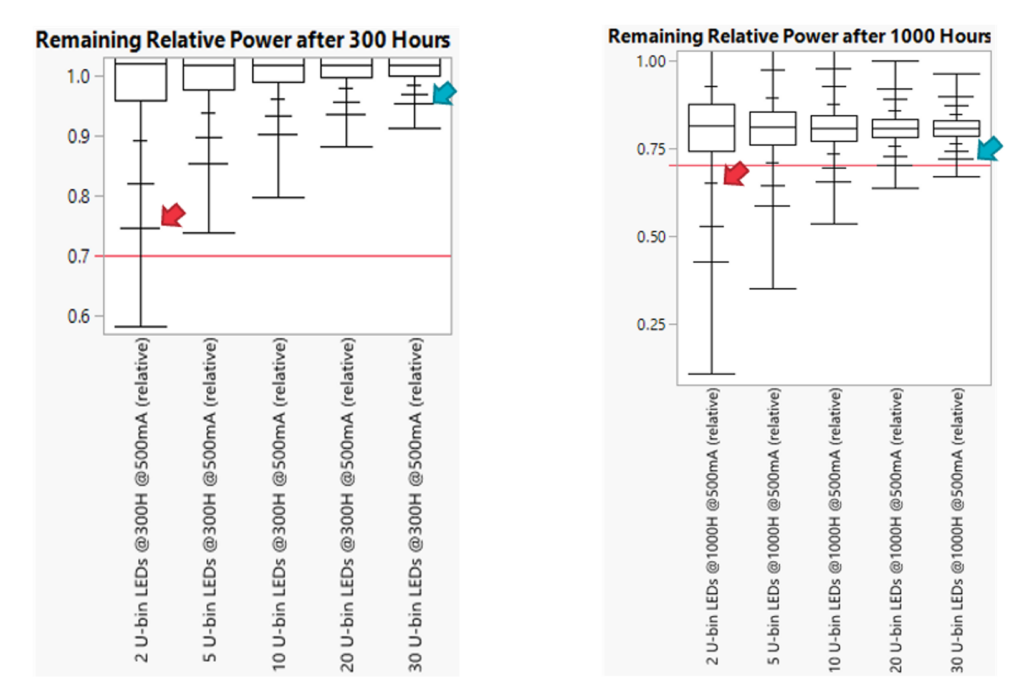
After 300 hours, 99.5% of the 50,000 two-LED engines have better than 75% of the initial power, and 99.5% of the 50,000 30-LED engines have better than 95% of the initial power. After 1,000 hours, 90% of the 50,000 two-LED engines have better than 70% of the initial power, and 99.5% of the 50,000 30-LED engines have better than 72% of the initial power.
Overall, the lifetime performance of our UVC LEDs make them the leading choice for consumer and industrial applications that depend on reliable and effective disinfection.