
Due to significant advancements in LED technology in recent years, coupled with the growing awareness and apprehension regarding mercury usage, UVC LEDs are increasingly viewed as a practical substitute for traditional mercury-based lamps – especially when it comes to water disinfection. However, one of the questions that always comes up when discussing the differences between mercury lamps and UVC LEDs has to do with efficiency, including wall plug efficiency (WPE).
In our previous article on WPE, we discussed a few methods for comparing WPE in lamps versus UVC LEDs. Now, we’ll discuss the impact of WPE in one specific water disinfection system: point-of-use.
When cost factors in
One element we didn’t previously discuss when considering the WPE of UVC LEDs is cost. Consider a residential POU water disinfection system. Millions of these are sold every month because they are ideal for ensuring safe drinking water for the everyday consumer. When UVC LEDs are used for disinfection, total cost of ownership decreases because LEDs are only used while disinfecting. Mercury lamps, however, will operate in idle mode or lamp cycling to minimize the amount of lamp warm-up time for the user.
Maybe a system using a 11W lamp may only consume 5.5W while in idle mode, and it would potentially operate at full power 10% of the time and in idle mode the other 90% of the time. At this rate, the system would draw a little over 53 kWh per year from the building electrical supply. According to the U.S. Department of Labor, as of May 2024, the average electricity kWh cost in the U.S. is $0.174, bringing the operating cost to just over $9 for a typical year.
Now consider the same system performance with an LED-based design. We can evaluate the annual energy cost for a few different LEDs with varied WPEs (see the below table). Even if we were to assume the same operating time with 10% full power and 90% idle mode, when an LED-based system is idle, there is no power draw from the light source.
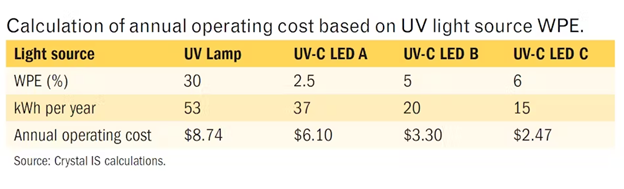
So as you can see in the table above, switching to a UVC LED system could save anywhere from 30%-70% on energy costs. Yet when you look at WPE, an increase from 5% to 6% results in less than $1 in annual savings – a negligible impact. The real advantage of switching from lamp to LED is sustainability. LEDs are significantly more energy efficient.
WPE and Design
When it comes to designing a new disinfection product, the discussions around WPE often focus on reducing the number of LEDs and decreasing heat load to make the product more cost effective. Which at the end of the day is less about WPE and more about efficiency – the impact of the total UVC power on the target microbe at the target wavelength.
Disinfection systems must adhere to specific disinfection standards tailored to the target microbe or biodosimer utilized in developing the GUV system, along with the spectral response of said biodosimer. The biodosimer serves as a substitute test microbe to ensure that the system achieves the advertised disinfection efficacy for its intended purpose. Industry organizations like the National Science Foundation (NSF) or the U.S. Environmental Protection Agency (EPA) set many of these standards, but some manufacturers may choose to use a specific microbe based on other regional market requirements. For instance, while the NSF identifies Qbeta as the standard microbe for certified systems, an OEM focusing on the European market might choose to employ Pseudomonas A in their designs.
To better understand the role of WPE in design, refer back to the table above. Because UVC LED B and C have similar WPEs, let’s compare the disinfection performance and cost for each.
UVC LED B: 5% WPE = 160 mW at 265 nm
UVC LED C: 6% WPE = 140 mW at 275 nm
To target E. coli bacteria, UVC LED C would require 20% more power to meet the same disinfection performance as UVC LED B. Even though there might be some benefit in WPE when it comes to annual operating costs, as a whole, UVC LED B offers a much more attractive option when it comes to LED budget in the system overall.
Conclusion
For many POU and lower-flow POE applications in the market today, existing commercial UVC LED performance meets OEM requirements, including for WPE performance. But what makes UVC LED-based equipment for these applications stand out is the many other advantages they offer, including a reduction in unplanned maintenance that helps offset overall system costs.
While WPE may become more important as the industry looks to incorporate UVC LEDs into municipal and wastewater applications, early adopters of UVC LED technology are already reimagining what reactor design could look like to solve for this.
At the end of the day, we’re seeing more and more POU and POE OEMs recognize the benefits of UVC LEDs, and as adoption increases, so too will the potential to serve larger populations.