
Aluminum Nitride (AlN) is an ultra wide bandgap semiconductor that provides foundational benefits in devices for optoelectronics, RF and power. As the electronics industry evolves, there’s a growing demand for devices that:
- Operate at higher temperatures
- Support higher power
- Offer improved reliability and efficiency
AlN meet these requirements better than traditional semiconductors. In the case of optoelectronics, the large bandgap of AlN (~6.2 eV) allows for emission at shorter wavelengths in the UVC range (200–280 nm). Light emitting diodes (LEDs) which emit in the UVC range broadly fall into two categories—AlN-based and Sapphire-based.
AlN vs. Sapphire Substrates for UVC LEDs
Lattice Match & Defects
- AlN substrates offer a close lattice match for AlGaN layers, enabling pseudomorphic growth (strained growth without defects).
- Sapphire substrates, by contrast, have a large lattice mismatch, causing misfit dislocations that thread through the material and degrade performance.
UVC LED Efficiency Breakdown
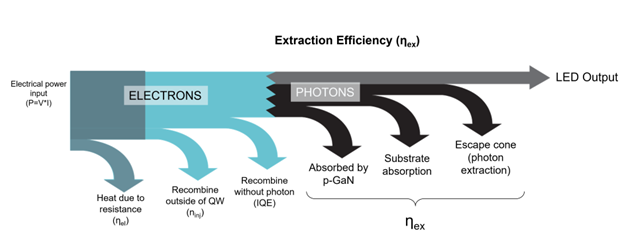
Efficiency in UVC LEDs is influenced by several factors:
- Electrical Efficiency (η_el)
- Measures how effectively electrons are delivered to the junction.
- Injection Efficiency (η_inj)
- How well carriers (electrons and holes) recombine in the quantum well.
- Internal Quantum Efficiency (IQE)
- Dictated by defect density.
- AlN substrates have fewer defects, leading to higher IQE, especially at shorter wavelengths like 265 nm.
- Extraction Efficiency (η_ex)
- Percentage of generated photons that actually escape the LED.
- Sapphire has high η_ex due to better refractive index matching, but much of the light is emitted from the side, which is harder to capture and focus.
- AlN substrates emit light predominantly from the top surface, making it easier to direct with optics.
Sidebar: UVC LEDs using AlN Template
Over the past few years, there has been an increase in manufacturers using an AlN template as opposed to bulk AlN for the growth of UVC LEDs. These use a thin AlN layer grown on another substrate (typically sapphire). While it provides an improved quality over sapphire alone, there are still dislocation defects due to lattice and thermal mismatch of the underlying substrate – sapphire has poor thermal conductivity. However, the light extraction for UVC LEDs using an AlN template will be better than sapphire albeit still constrained by light scattering and will often employ the use of reflectors to direct the light out of the LED package.
AlN is essential for next-gen UVC LED performance due to its low defect density and high internal efficiency. While photon extraction still lags sapphire-based UVC LEDs, improvements are underway using best practices in optoelectronics design. AlN substrates enable more useful and directable light, especially important for lower cost packages and applications using high density die arrays. Additionally, the improved thermal performance at high input currents have the potential for higher light output at the UVC wavelengths.