
LEDs which emit UVC wavelengths from 260 nm to 270 nm are increasingly becoming the technology of choice in on-demand and low flow disinfection applications. But for engineers used to designing lamp-based systems, it can be daunting to understand how to correlate LED specs to legacy lamp ratings. Understanding how to translate data sheet values to design parameters can be a completely different approach. Unlike traditional UV lamps, LEDs are solid state devices that will have a range of characteristics based on the inputs and operating conditions.
A Light Emitting Diode (LED) is a semiconductor device that emits light when current flows through it. The wavelength of the emitted light depends on the bandgap of the semiconductor material used.
LED Structure and Behavior
- LEDs are diodes, meaning they allow current to flow only in the forward direction.
- They emit directional light, unlike low-pressure mercury lamps, which emit 360-degree radiation.
- UVC LEDs emit light over a continuous spectrum with a typical full width at half maximum to define the photons available in a particular emission range.
LEDs are often binned based on optical output power for consistent system performance. When designing systems with LEDs, it’s important to use constant current mode as small voltage changes can cause large current shifts—thereby impacting the output power.
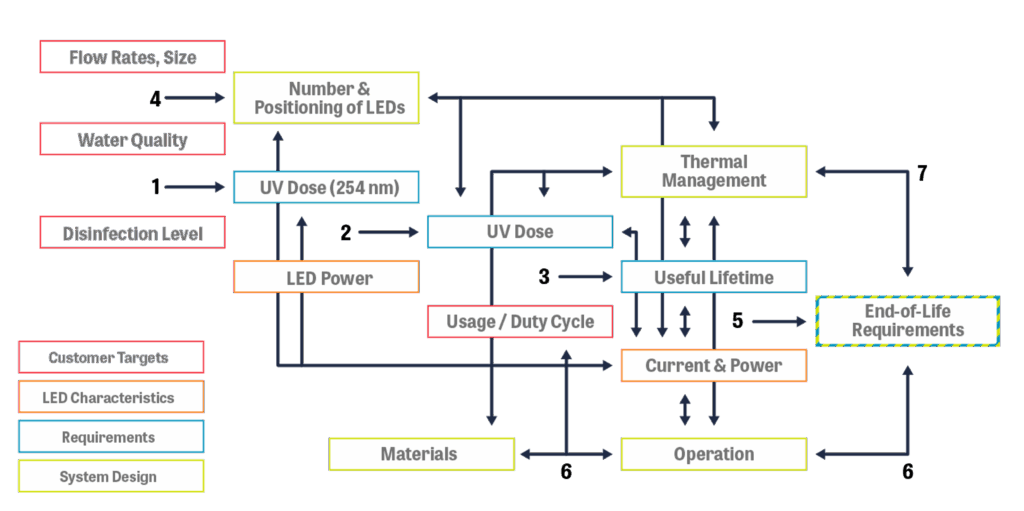
LED Characteristics based on design parameters
- Wavelength Shift: Typically, peak wavelength increases slightly with operating temperature or changes in drive current however it is often not significant enough to impact microbial inactivation.
- Output Power: The amount of photons emitted from a device within a given wavelength range is impacted by the drive current and the operating conditions. Increasing the current will increase the number of photons emitted along with the heat generated by the device. Conversely, decreasing current will reduce the output power and extend the useful life of the device.
- Output Decline Over Time: Unlike lamps where there will be a sudden failure at end of life, the light output of an LED will degrade gradually over the lifespan of the product. This lifespan is impacted by a number of factors, including drive current and junction temperature, so it is important to consider these conditions to determine the end of life requirements.
Learn more about basic design principles from the knowledgebase on our website, including best practices in thermal management and the distinction between lifetime and reliability.